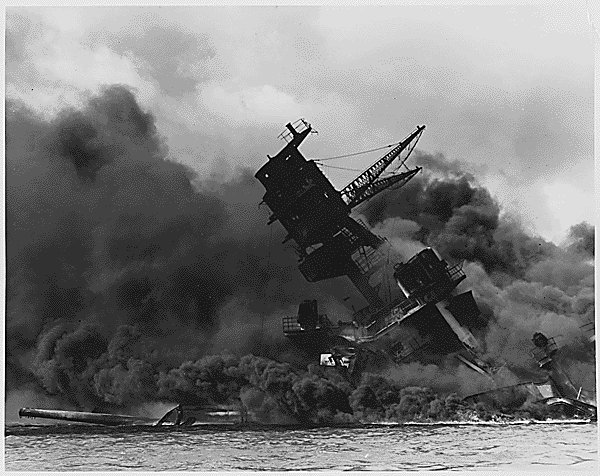
Monday, September 11, 2006

Time And Place


December 7, 1941

November 22, 1963

September 11, 2001


It seems every generation has a moment in its lifetime when a single incident captures its attention and indelibly engraves it in its collective memory. People can recall where they were when they heard the news in incredible detail. This phenomena seems to create a bond and give shape to the identity of those who lived in that time.

This day is such a moment in time for me.

I was working for a wholesale magazine distributor in their return department, just 10 months into my employment with them, when the news broke. Someone from the front office made the announcement. The department's supervisor had a small radio to which she was listening and quick changed to a local radio station which was broadcasting a national feed. Work in my department came to a near standstill as we listened to the events unfold for about the next hour.

My first reaction was that of disbelief. Then, again, how many people thought something like this could happen? Once the reality and gravity of the situation became apparent, whatever feelings of being safe and secure within the borders of this country were now shaken. I was very aware of the tactic of suicide bombers in the Middle East. Would this now open the way for that to happen on our soil? Why wouldn't someone target a shopping mall, school building, civic center, or even a house of worship, now that there was a sense of being emboldened by this?

I felt a loss of power, even though I had none in this situation. I felt a sense of helplessness, knowing there was nothing I could do to prevent something from happening to me. While the loss of human life is tragic, the psychological aspect was affectively sending its shockwaves throughout the rest of the country. But I also felt something else, something which began to counter whatever terror wanted to reside with me.

I felt a sense of hope. I realized that this was in God's hands. There was nothing I could do but to trust in His infinite power, to let Him straighten this crooked line, to place this sense of fear and loss of innocence in His care. A classic case of "letting go and letting God."

The high school volleyball matches I was scheduled to officiate that night were postponed. I spent the evening at my favorite sports bar, but no games were played. The media coverage was still in full force and I was able to catch some of the clips of the horrific events after the first plane hit. I was speaking to an acquaintance of mine while our eyes were glued to a TV set. His reaction was not one of fear. He was angry that someone would act like a cat and use the soil of the United States as kitty litter, although he used a little more colorful language than I.

As we left the bar that night, we both saw a red dot in the southwestern evening sky. It seemed it was not moving. We had no idea what it was. Mars? A plane? We never did come to a conclusion, even after a few days. (I would be interested in knowing if anyone else saw that.)

The next day at work I found Old Glory in one of the lockers. The flagpole in front of the building had been empty for a long time. During a break, I hoisted our country's flag to the top. To this day, as far as I know, it is still flying, although another one has taken its place.

I know the images which have come from this are not ones we wish to remember. It seems there are some who wish we could somehow forget the entire day. We cannot; we must and will remember.

For me and my generation, this is the "day which will live in infamy."

Monday, September 04, 2006

The Dash

I found this on the 'blog Life Behind The Zion Curtain. The 'blogmistress, Catherine Garcia, sent me the background to this. The poem is by Linda Ellis. It is about how we spend our lives between the day we are born to the day we pass away. On this Labor Day, it is also a reminder of the words of John Paul II, who said that work was created for man, not man for work.

Go here to view.

Our first "job" is to love.

Jesus Had No Servants

Jesus had no servants, yet they called Him Master.
He had no degree, yet they called Him Teacher.
He had no medicines, yet they called Him Healer.
He had no army, yet kings feared Him.
He won no military battles, yet He conquered the world.
He committed no crime, but they crucified Him.
He was buried in a tomb, yet He lives today.
Feel honored to serve such a Leader Who loves us.

(Fedora Doff to Catherine Garcia, who has graciously sent this to me as well.)

God Lives Under The Bed

Fedora doff to Catherine Garcia, who also has this posted on her 'blog in its original form. I have edited it slightly.

++++++++++

I envy Kevin. My brother Kevin thinks God lives under his bed. At least that's what I heard him say one night. He was praying out loud in his dark bedroom, and I stopped to listen. "Are you there, God?" he said. "Where are you? Oh, I see. Under the bed."

I giggled softly and tiptoed off to my own room. Kevin's unique perspectives are often a source of amusement. But that night something else lingered long after the humor. I realized for the first time the very different world in which Kevin lives.

He was born 30 years ago, mentally disabled as a result of difficulties during labor. Apart from his size (he's 6-foot-2), there are few ways in which he is an adult. He reasons and communicates with the capabilities of a 7-year-old and he always will. He will probably always believe God lives under his bed, Santa Claus is the one who fills the space under our tree every Christmas, and airplanes stay up in the sky because angels carry them.

I remember wondering if Kevin realizes he is different. Is he ever dissatisfied with his monotonous life? Up before dawn each day, off to work at a workshop for the disabled, home to walk our cocker spaniel, return to eat his favorite macaroni-and-cheese for dinner, and later to bed. The only variation in the entire scheme is laundry, when he hovers excitedly over the washing machine like a mother with her newborn child.

He does not seem dissatisfied. He lopes out to the bus every morning at 7:05, eager for a day of simple work. He wrings his hands excitedly while the water boils on the stove before dinner, and he stays up late twice a week to gather our dirty laundry for his next day's laundry chores.

And Saturdays-oh, the bliss of Saturdays! That's the day my Dad takes Kevin to the airport to have a soft drink, watch the planes land, and speculate loudly on the destination of each passenger inside. "That one's goin' to Chi-car-go!" Kevin shouts as he claps his hands. His anticipation is so great he can hardly sleep on Friday nights.

And so goes his world of daily rituals and weekend field trips. He doesn't know what it means to be discontent. His life is simple. He will never know the entanglements of wealth of power, and he does not care what brand of clothing he wears or what kind of food he eats. His needs have always been met, and he never worries that one day they may not be.

His hands are diligent. Kevin is never so happy as when he is working. When he unloads the dishwasher or vacuums the carpet, his heart is completely in it. He does not shrink from a job when it is begun, and he does not leave a job until it is finished. But when his tasks are done, Kevin knows how to relax. He is not obsessed with his work or the work of others.

His heart is pure. He still believes everyone tells the truth, promises must be kept, and when you are wrong, you apologize instead of argue. Free from pride and unconcerned with appearances, Kevin is not afraid to cry when he is hurt, angry or sorry. He is always transparent, always sincere.

And he trusts God. Not confined by intellectual reasoning, when he comes to Christ, he comes as a child. Kevin seems to know God--to really be friends with Him in a way that is difficult for an "educated" person to grasp. God seems like his closest companion.

In my moments of doubt and frustrations with my Christianity I envy the security Kevin has in his simple faith. It is then that I am most willing to admit that he has some divine knowledge that rises above my mortal questions. It is then I realize that perhaps he is not the one with the handicap. I am. My obligations, my fear, my pride, my circumstances--they all become disabilities when I do not trust them to God's care.

Who knows if Kevin comprehends things I can never learn? After all, he has spent his whole life in that kind of innocence, praying after dark and soaking up the goodness and love of God. And one day, when the mysteries of heaven are opened and we are all amazed at how close God really is to our hearts, I'll realize that God heard the simple prayers of a boy who believed that God lived under his bed.

Kevin won't be surprised at all!

++++++++++

Trust me when I tell you that whoever deos not accept the kingdom of God as a child will not enter into it.
Luke 18:17

Wednesday, August 30, 2006

Facets Of Love

I am fortunate I have things to post, sent by other people, when my own inspirations are not forthcoming. This is part of another forwarded e-mail, edited in format but not content:

++++++++++

God's Love

We call it mercy; it is God's forgiving love.
We call it providence; it is God's caring love.
We call it kindness; it is God's understanding love.
We call it Christ's Passion and Death; it is God's proven love.
We call it happiness; it is God's encouraging love.
We call it the will of God; it is God's unerring love.
We call it Heaven; it is God's rewarding love.
We call it eternity; it is God's unending love.

++++++++++

The man without love has known nothing of God, for God is love....God is love, and he who abides in love abides in God, and God in him.
1 John 4: 8, 16b

Tuesday, August 22, 2006

Regina Coeli

Today the Church celebrates the occassion when the Blessed Virgin Mary, Mother of God, was given the crown as Queen of Heaven and Earth.

Her role is that of Queen Mother, a powerful advocate for us as found in the story of the wedding feast at Cana. While we supplicate her, we are also reminded of the words she told the wine stewards: "Do everything He tells you." (UPDATE: Julie D. gets a fedora doff for this article explaining the Queenship of Mary.)

Where she has gone, we hope to follow.

**********

Salve, Regina, mater misericordiae: vita, dulcedo, et spes nostra, salve. Ad te clamamus exsules filii Hevae. Ad te suspiramus, gementes et flentes in hac lacrimarum valle. Eia, ergo, advocata nostra, illos tuos misericordes oculos ad nos converte. Et Iesum, benedictum fructum ventris tui, nobis post hoc exsilium ostende. O clemens, O pia, O dulcis Virgo Maria. Amen.

++++++++++

Hail holy Queen, mother of mercy, our life, our sweetness, and our hope. To thee do we cry, poor banished children of Eve. To thee do we send up our sighs, mourning and weeping in this valley of tears. Turn then, most gracious Advocate, thine eyes of mercy toward us. And after this our exile show unto us the blessed Fruit of thy womb, Jesus. O clement, O loving, O sweet Virgin Mary. Amen.

Wednesday, August 16, 2006

A Son Is Given

Congratulations to Rich Leonardi. He is the proud parent of a healthy baby boy, delivered yesterday afternoon.

Details here.

Monday, August 07, 2006

Sunday, August 06, 2006

Bumper Sticker Shock

On my way home from Mass I saw this bumper sticker on the back of a vehicle:

PRO-CHILD/PRO-CHOICE

I thought to myself, "Does this person see the contradiction?" Granted, the first thing to do is define what is meant by "pro-child". For the sake of this post, let it mean to be an advocate for policies to help children. Now, tell me, how does supporting the right to choose an abortion a good policy for children when it denies the right for a child to exist?

Poor (pro-) choice, indeed. Man is a consistant inconsistancy, are we not?

Friday, August 04, 2006

Formal Complaint

Father Jan Larson is a priest of and liturgical consultant for the Archdiocese of Seattle. He wrote an article which appeared in the July 6, 2006 edition of the Inland Register, the official news magazine of the Diocese of Spokane, WA.

Jeff Miller has already fisked this. Hey, I know good material when I steal, uh, see it. (And a Fedora Doff to the Curt Jester for the original post.) My comments are in red.

Liturgy Reflections: Mysterious Liturgy
A good headline, in my very humble opinion, usually has a double meaning, sometimes ironic. The opening paragraph leads you into the twist.

I was recently watching a part of the daily televised liturgy on EWTN (Eternal Word Television Network). The liturgy there is an odd mix of English and Latin, while following the texts of the current Roman Missal. And would it be an odd mix to hear English and Hebrew in a Jewish synagogue? Or English and Arabic in an Islamic mosque? What's wrong with using the official language of the Church? The priest and ministers of the liturgy look way too somber and serious. You are encountering the living God. I refer you to Moses, Isaiah, Elijah, and St. Peter as examples of what demeanor is appropriate. Those gentlemen certainly weren't in a "happy to see You" mood. Could it be...awe? The ritual is performed with all the exaggerated exactness of the pre-Vatican II Latin liturgy. The Mass is overly formal and mechanical. You mean actions are done thoughtfully, reverently, and respectfully? The lack of those elements are the biggest complaints I encounter about liturgical practices. Needless to say, there are no women allowed in the sanctuary area, there is no procession with the gifts, no Sign of Peace, and, of course, no Communion from the cup for the lay people who are present. Comparing apples to oranges, maybe? Observation or criticism? The liturgy, in effect, is unlike anything that Catholics experience in the vast majority of Catholic parish churches. Yes, it is. And is it because how the rite is performed maybe matches what the actual intent of all those documents on the liturgy produced since Vatican II?

I am certain that the planners of these liturgies would explain their differences from parish liturgies with the familiar refrain that the post Vatican II liturgical reforms have taken too much of the mystery away from the Holy Mass. They have. Certainly, they say, allowing the congregation full, active and conscious participation (once that phrase is properly translated, we may have the true intent of what the laity's proper conduct and role is) in the ritual is what empties the rites of their mystery, so the further we keep the secular congregation away from the clerical activity and space, the better to preserve the liturgy's mystery. Thus the need to eliminate any personal touch with the lay folks, and, by all means, do not allow them to communicate with each other, even to wish one's neighbor the peace of the risen Christ. I'm sorry. The Mass is not about "any personal touch with the lay folks". I am not there to communicate with the rest of the congregation when I assist at Mass. I am there to offer my public worship to God as an individual and as part of the Mystical Body of Christ. Anything there which doesn't help me to focus on God as an act of adoration, in my opinion, doesn't belong. (One wonders what these people think of the pope as he hugs and kisses the children who present him with the gifts to be offered, giving each of them a small gift as a remembrance of the liturgy. Perhaps it is all right for the pope to be warm and personable during the liturgy, but inappropriate for lesser souls.) Straw man. Sounds like a Pharasee trying to trap Jesus.

I think the folks responsible for these stuffy liturgies are confusing mystery with mystification. I think the folks responsible for liturigies seemingly void of meaningful worship are confusing man with God. It's not about us; it's about Him. Rites that express mystery will invite people into the unknown, into what lies beyond the action of the ritual. Agreed. Liturgy done well this way will cause people to ask, "How does this ritual which I can see, and in which I am participating, lead me more deeply into the beyond, into life of the God of mystery whom I cannot see?" And where is the proper catechism regarding that? Faith seeking understanding. Mystification, on the other hand, leads one to ask, "What on earth does that mean, and why in God's name is he doing that?" No, it performing that leads to being mystified, which is what seems to be done at times. Let's label it for what it is--confusion. The confusion of 40+ years of experimentation and watering down of the liturgy which has contributed to a shrinking of the Faith. If tradition means "handing down/on", why would I give anyone these thread-bare garments?

Luke Timothy Johnson, author of The Creed and other works, wrote recently in Commonweal magazine about the concerns of many conservative Catholics that paying attention to one another during the liturgy (what he calls "horizontal" values) have distracted us too much from the "vertical" values -- our relationship with God and Christ. Again, it goes back to what should be the focus. (Hint: Is it He?) He writes: (Note--Slight changes with the quotation marks compared to the original, due to my making this section a block quote.)
Critics who complain that these "horizontal" values have been realized at the cost of "vertical" ones, that mystery and a sense of the transcendent have disappeared among all the folksiness, need gently to be reminded of the difference between mystery and mystification. And those who state this need to be reminded of Who we worship. And isn't that what all liturgy is about? God is God, not a supernatural "buddy". We who grew up in a Tridentine liturgy and who witnessed the travails of reform can bear an important witness to those of a younger generation who hanker after the "good old days." You have been a poor witness. Some fear they have missed the solemn richness of Catholic piety (No, that's not correct; anyone seeing the Masses celebrated by Pope Benedict XVI knows that when done according to norms is just as rich), believing that the reformed liturgy comes dangerously close to Protestant worship (This is where I have to give a nod to the so-called "RadTrad" types who, I think, do have serious and legitimate concerns about the Novo Ordo; having directed adult choirs in both Lutheran and Methodist churches, they make a very good point about it being neo-Protestant), and that the perpetual adoration of the Blessed Sacrament is the essential expression of authentic Eucharistic theology (Perhaps because the focus is away from the Real Presense during Mass, a fallout of lack of proper focus). But we are in a position to state that for every example of splendid monastic liturgy in the old days there were countless examples of parish worship that appeared meaninglessly mechanical. No one is saying there weren't liturgical abuses in "the good old days". But perhaps the laity is sensing something's not right about this day and age.

We know that birettas and fiddle-back chasubles, mumbled (and often mangled) Latin, and truly execrable renditions of Gregorian chant were no more aesthetically than theologically impressive. Having lived through "speed-typing" Masses guaranteed to last no more than twenty minutes, we can point to the greater seriousness, even greater solemnity, of parish worship today. Those who call contemporary worship insufficiently sacred literally do not know what they are talking about. Then, Mr. Expert, explain to me why people do not enter or exit a church with seemingly any sense of reverence, that "in this place" where they are about to encounter God they will chat with their neighbors before (in hushed tones) and after (in a normal voice) Mass as if they have not been affected by it, that they act like a church is just another building and not a place set aside as sacred, if the way we worship today is better than before Vatican II. Lex credendi legem statuat supplicandi.

As for the growing similarity (because we have diminished the Real Presence due to our reform?) among the Eucharistic celebrations of Catholics and Protestants, we should rejoice that Catholics now feel at home at Lutheran, Methodist, and Episcopalian worship (because there seems to be no difference?), and that our Protestant neighbors have gained much through our process of renewal and reform. The Catholic form of worship remains a strong motivation for conversion among adults (because they have found Jesus Christ, Body and Blood, Soul and Divinity, present in our Mass, despite the obstrufication). As we (meaning people like Fr. Larson, your ilk, and yourself) have known all along, God works powerfully through the words and gestures of the liturgy (straightening out our crooked lines?); the hard work of renewal has served to make God's work plain and public each Sunday when we gather as "church." Again, where is the focus when you use that word? Your comments seem obvious to me as to where.
It is people such at Fr. Larson and Mr. Johnson who seem to be satisfied with the events of a post-Vatican II. But it seems they have replaced substance with style. Do they bristle at Liturgiam Authenticam?

The hard work of renewal hasn't even started.